


Jyotish – The Eye of the Vedas
Published On : May 22, 2025 | Author : Astrologer Pt Umesh Chandra Pant 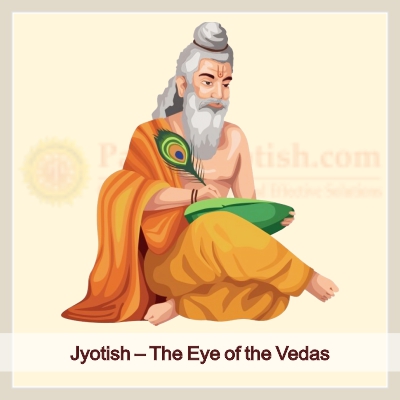
Jyotish The Eye of the Vedas: Spiritual Significance and Ancient Wisdom by PavitraJyotish
Among India’s most ancient intellectual treasures, the Vedas hold the highest place. From these Vedas emerged an essential and illuminating branch known as Jyotish (Vedic Astrology), often referred to as the “eye of the Vedas.” Just as the crest feather is significant for a peacock and a gem for a serpent, Jyotish holds a place of prominence among the six Vedangas (limbs of the Vedas). PavitraJyotish, under the expert guidance of Astrologer Pt Umesh Chandra Pant, brings the true spiritual significance of Jyotish to the modern seeker.
Speak directly with Pt Umesh Chandra Pant through Telephonic Consultation and find answers to your life’s key concerns.
Vedic Astrology and Jyotish Shastra: Origin of Jyotish in Vedas
The Vedas encompass a complete body of knowledge—covering everything from spirituality and ethics to astronomy, medicine, and ritual practices. To help interpret and apply this vast wisdom effectively, ancient sages developed six Vedangas: Shiksha (phonetics), Kalpa (rituals), Vyakarana (grammar), Nirukta (etymology), Chhanda (metrics), and Jyotish (astrology). Among these, Jyotish guides us to the right time and moment for every significant action in life.
Not only does Jyotish have a practical aspect, but it also represents a spiritual bridge between humans and the divine. With the Ancient Indian Astrology System, Jyotish is categorized into three main divisions—Siddhanta, which deals with astronomical calculations; Samhita, which predicts events like earthquakes, weather changes, and social phenomena; and Hora, which focuses on Personal Horoscope and life predictions based on one’s time and place of birth.
Because writing was not yet developed in ancient times, this knowledge survived through oral tradition and strong memory. The sages and seers who attained this knowledge through deep meditation and observation passed it down from generation to generation. As a result, countless rishis contributed to the systemization and enrichment of Jyotish, transforming it into a refined and reliable field of study.
Even today, Jyotish—guided by PavitraJyotish and Astrologer Pt Umesh Chandra Pant—is not merely a belief system. Instead, it stands as a science of observation, calculation, and spiritual insight. Moreover, it connects the individual to cosmic rhythms and empowers one to make informed and auspicious decisions, rooted in time-tested wisdom. It holds deep spiritual significance, offering a sacred lens through which individuals understand their life path, karma, and inner evolution.
Kaal Jnana – The Knowledge of Time and Cosmic Order
Vedic Astrology has long been revered for offering profound insights into life’s timing and rhythm. One of the most profound contributions of astrology is the concept of Kaal Jnana (knowledge of time). In Vedic philosophy, time is not just linear or mechanical; rather, it is a powerful, divine principle that governs all creation. Since every moment carries unique energy, Jyotish helps identify that energy, so you can make conscious and harmonious life decisions.
The Rigveda states:
“Kaalah Kalayataam Shreshtah”
(कालः कालयतां श्रेष्ठः)
“Among those who understand time, Time itself is supreme.”
According to Astrologer Pt Umesh Chandra Pant, recognizing this divine flow of time is crucial for determining the right muhurta (auspicious timing) for important activities like marriage, travel, business ventures, or rituals. Failing to recognize the cosmic clock often leads to delays, obstacles, or failure.
PavitraJyotish utilizes Jyotish Shastra to align your actions with universal timing, ensuring you don’t swim against the cosmic tide. By understanding Dashas (planetary periods), Gochara (transits), and Muhurta, one can significantly increase the chances of success in both worldly and spiritual endeavors. The spiritual significance of Jyotish lies in its ability to illuminate the karmic path of the soul. It acts as a guiding light, helping individuals navigate life’s challenges while staying aligned with their higher purpose. Through Jyotish, seekers can gain clarity about their spiritual duties, cleanse karmic imprints, and make choices that support inner awakening.
Karma and Rebirth – The Astrological Perspective
Astrology deeply integrates with the karmic philosophy of Sanatana Dharma. According to the Ancient Indian Astrology System, every individual is born with a unique karmic blueprint that reflects their past actions (Purva Janma) and influences their current life’s circumstances.
The Bhagavad Gita beautifully supports this idea:
“Gahanaa Karmano Gatih”
(गहना कर्मणो गतिः)
“The path of karma is indeed mysterious.”
— Bhagavad Gita
According to Jyotish, your Janam Kundli or Janampatri reveals this karma through planetary placements and aspects. While malefic planets may indicate unresolved karmas, benefic ones point toward blessings earned. Astrologer Pt Umesh Chandra Pant, through PavitraJyotish, explains that understanding your birth chart is like decoding a spiritual roadmap, helping you overcome negative patterns and live with awareness.
Although astrology doesn’t claim to change fate, it offers insight into how you can respond wisely. Moreover, as you cultivate acceptance and responsibility—tools that are invaluable for both material success and spiritual progress—you move closer to self-mastery. Thus, this is the spiritual significance of Jyotish—it serves as a guiding light that encourages inner transformation, helping individuals align their actions with higher wisdom and karmic understanding. In fact, this alignment is what empowers you to take control of your spiritual growth. Ultimately, Jyotish helps you gain clarity about your life’s path and purpose. Therefore, it’s more than prediction—it’s a tool for conscious evolution.
Connect visually with Pt Umesh Chandra Pant via Video Consultation and receive authentic, detailed guidance for your life path.
Graha Shakti – The Planetary Energies Within You
Jyotish – the Eye of the Vedas holds a special place in understanding life’s deeper truths. In Vedic astrology, the Navagrahas (nine planetary deities) are considered cosmic forces that govern various aspects of life—from health and relationships to intellect and career. It is important to realize that these are not just physical celestial bodies but also divine intelligences with specific influences.
Each graha has a personality and domain:
Surya (Sun): Soul, power, ego
Chandra (Moon): Emotions, mind
Budha (Mercury): Communication, logic
Shukra (Venus): Love, beauty
Mangal (Mars): Courage, aggression
Brihaspati (Jupiter): Wisdom, wealth
Shani (Saturn): Discipline, karma
Rahu & Ketu: Shadow planets indicating spiritual tests and karmic traps
The Brihat Parashara Hora Shastra, the foundational text of Vedic astrology, affirms:
“Grahaaṇām Aadi Devataaḥ Daivatam Chopalakṣayet”
(ग्रहाणां आदि देवताः दैवतं चोपलक्षयेत्)
“One must observe the deities governing the planets for accurate understanding.”
Jyotish – the Eye of the Vedas teaches us to internalize these energies—by strengthening weak planets through remedies and balancing excesses through spiritual practices. Consequently, this brings about greater self-mastery and mental peace.
Astrological Remedies – Science, Faith, and Energy Alignment
Remedies in Vedic astrology are not superstitions, but subtle energy-corrective methods prescribed after deep chart analysis. Astrologer Pt Umesh Chandra Pant, at PavitraJyotish, emphasizes that remedies act like spiritual prescriptions—individualized and time-sensitive. They reflect the spiritual significance of Jyotish, guiding individuals through karmic imbalances toward clarity, peace, and inner transformation.
Common remedies include:
Mantra chanting: Strengthens planetary vibrations. (e.g., “Om Namah Shivaya” or “Om Shum Shaneshcharay Namah” for Saturn)
Gemstones: Conductors of planetary energies (e.g., Blue Sapphire for Shani, Yellow Sapphire for Jupiter, Ruby for Sun, Pearl for Moon, Coral for Mars, etc.)
Yantras and Rudraksha: Sacred geometries and beads for protection and focus.
Charity and fasting: To purify karmic burden and attract blessings
The Atharva Veda supports this:
“Yatha Rudro Rudrebhir Vasubhir Vasunā Sah”
(यथा रुद्रो रुद्रेभिर्वसुभिर्वसुना सह)
“As Rudra aligns with Rudras and Vasus, let him align with us in harmony.”
Such remedies align with your grahas and are not one-size-fits-all. Only a competent Best Astrologer in India can identify which combination will work best for your unique karmic code.
Spiritual Significance of Jyotish as a Path to Self-Mastery and Enlightenment
While astrology helps solve worldly problems, more importantly, its highest purpose is to awaken inner awareness. In fact, it teaches us to rise above ego, work in tune with nature’s law, and fulfill our soul’s journey. Moreover, astrology reminds us that behind every joy and struggle lies a cosmic order encouraging our growth. This is the spiritual significance of Jyotish—therefore, it is not merely a tool for prediction, but a divine light guiding one’s soul toward truth, dharma, and liberation. Ultimately, Jyotish leads us on the path of higher consciousness.
As per ancient wisdom:
“Atmavat Sarvabhuteshu”
(आत्मवत् सर्वभूतेषु)
“See the Self in all beings.”
— Yajurveda
By practicing astrology spiritually, one cultivates humility, compassion, and purpose. It becomes a sadhana (spiritual discipline) rather than just a solution-provider. When you combine astrology with meditation, introspection, and dharma (right action), it becomes a powerful tool for enlightenment.
Experience personal attention and accurate predictions through a Face to Face Consultation with Pt Umesh Chandra Pant.
FAQs on Spiritual Significance of Jyotish
Question: What does “Jyotish the Eye of the Vedas” mean?
Answer: “Jyotish the Eye of the Vedas” refers to Vedic Astrology’s role as the guiding light of ancient Indian wisdom. Indeed, it is considered the foundation for understanding time, karma, and destiny. Therefore, it holds a significant place in spiritual and practical life. Moreover, it is an essential part of the six Vedangas in Vedic tradition, thus reflecting its deep-rooted importance in Indian philosophical thought.
Question: How does Vedic Astrology differ from other astrology systems?
Answer: Vedic Astrology, or Jyotish Shastra, uses astronomical calculations and spiritual principles rooted in the Vedas. Unlike Western astrology, it focuses on timing, karma, and remedies based on deep analysis, as practiced by PavitraJyotish and Pt Umesh Chandra Pant.
Question: Why is Jyotish considered a scientific system?
Answer: Jyotish the Eye of the Vedas relies on precise observations, mathematical calculations, and centuries of tradition. Its methods are systematic, focusing on planetary influences and timing, making it both scientific and spiritual.
Question: What remedies are offered in Vedic Astrology at PavitraJyotish?
Answer: Astrologer Pt Umesh Chandra Pant recommends personalized remedies such as mantras, gemstones, rituals, and charity. These are based on your unique birth chart to harmonize planetary energies and support personal growth, reflecting the spiritual significance of Jyotish in guiding one’s inner and outer journey.
Question: How can Jyotish help with spiritual and practical life challenges?
Answer: Jyotish, the Eye of the Vedas, guides you to align with the universal order, helping you understand your karmic path and, consequently, make better decisions. At PavitraJyotish, you’ll find holistic solutions for both spiritual awakening and daily challenges under expert guidance.
Must Read
Brief Introduction of Astrology and About Founder PavitraJyotish Pt Umesh Chandra Pant